15 Best AI Tools for Digital Marketing in 2026
Updated for 2026.
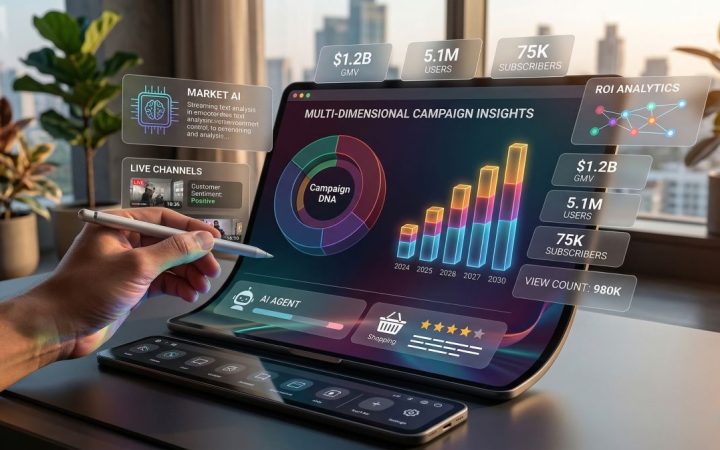
AI has moved from an experiment to an everyday part of a marketer’s job. In 2026, the same person can research a market, write a campaign, design creatives, produce a video with a voice-over, launch ads and build an automated follow-up – often in a single afternoon. This guide lists the 15 best AI tools for digital marketing in 2026, what each one is genuinely good at, whether it has a free plan, and how to combine them into a simple AI stack for your role.
In short: the most useful AI tools for digital marketing in 2026 are ChatGPT, Gemini and Claude for thinking and writing; Perplexity and NotebookLM for research; Canva and Adobe Firefly for design; Veo, CapCut, HeyGen and ElevenLabs for video and voice; the built-in AI in Google Ads and Meta Ads for campaigns; Semrush for SEO and AI visibility; and n8n for automation and AI agents. You don’t need all of them – pick one tool per job and learn it well.
AI is changing every industry, from marketing to the future possibilities of AI in healthcare. For marketers, the opportunity is practical: less time on repetitive work, more time on strategy and creativity. If you’re new to the idea, start with our guide to what AI-driven digital marketing is.
What Is an AI Marketing Tool?
An AI marketing tool uses artificial intelligence to do or speed up marketing work: writing, designing, editing video, analysing data, targeting ads or responding to customers. In 2026 these tools fall into three groups:
- AI assistants such as ChatGPT, Gemini and Claude that you talk to and that handle many tasks.
- Specialist AI tools for one job, such as Canva for design or ElevenLabs for voice.
- AI built into platforms you already use, such as Google Ads, Meta Ads, Google Analytics and WhatsApp, plus automation tools that connect them into AI agents.
AI Tools for Digital Marketing in 2026 at a Glance
| Tool | Best for | Free plan |
|---|---|---|
| ChatGPT | All-round writing, ideas, analysis, images | Yes |
| Google Gemini | Google Workspace, research, images and video | Yes |
| Claude | Long-form writing, documents, careful analysis | Yes |
| Perplexity | Research with sources | Yes |
| NotebookLM | Learning from your own documents | Yes |
| Canva AI | Social posts, ads and brand design | Yes |
| Adobe Firefly | Commercially safe images and editing | Limited |
| Google Veo | AI video generation | Limited |
| CapCut | Fast Reels and Shorts editing | Yes |
| ElevenLabs | Voice-overs and dubbing | Yes |
| HeyGen | AI avatars and video translation | Limited |
| Google Ads AI | Search, Performance Max and AI Max campaigns | Built in |
| Meta Advantage+ | Automated Facebook and Instagram ads | Built in |
| Semrush | SEO, competitor research, AI visibility | Limited |
| n8n | Automation and AI agents | Yes (self-hosted) |
Pricing and free limits change often, so check each tool’s website before you buy.
15 Best AI Tools for Digital Marketing in 2026
1. ChatGPT – the All-Round AI Assistant
ChatGPT by OpenAI is still the most widely used AI assistant. Marketers use it to brainstorm campaign ideas, write ad copy and emails, create content outlines, analyse spreadsheets, generate images and research competitors. Custom GPTs and projects let you save your brand voice and reuse it, and its agent features can carry out multi-step tasks on the web.
Best for marketers: first drafts, ad variations, content calendars, data analysis.
Try this prompt: “Act as a performance marketer. Write 10 Meta ad hooks for a digital marketing course aimed at final-year BCom students in Nashik. Keep each under 12 words.”
2. Google Gemini – AI Across Google’s Ecosystem
Gemini (formerly Bard) is Google’s AI assistant. Its biggest advantage for marketers is integration with Gmail, Docs, Sheets, Slides and Drive, plus Deep Research reports and strong image and video generation. It is also closely tied to the way Google Search now answers questions with AI Overviews and AI Mode.
Best for marketers: research reports, working inside Google Workspace, quick images and video concepts.
3. Claude – for Long-Form Writing and Careful Analysis
Claude by Anthropic is known for natural, well-structured writing and for handling long documents such as reports, transcripts and full websites. Marketers use it for blog posts, landing page copy, editing, brand guidelines and turning messy research into clear strategy.
Best for marketers: long-form content, editing, strategy documents, reviewing large files.
4. Perplexity – AI Research with Sources
Perplexity answers questions using live web results and shows its sources, which makes it ideal for market research, competitor analysis and finding statistics you can verify. Always click through to the original source before quoting a number.
Best for marketers: fast research, trend spotting, fact-finding with citations.
5. NotebookLM – Learn from Your Own Documents
Google’s NotebookLM lets you upload PDFs, docs, websites and videos, then ask questions that are answered only from those sources. It can also create audio and video overviews. Marketers use it to digest research reports, customer interviews and product documents quickly.
Best for marketers: summarising research, preparing briefs, studying new topics.
6. Canva AI – Design for Everyone
Canva’s AI features (Magic Studio and Canva AI) can generate designs from a prompt, resize a post for every platform, remove backgrounds, write copy and apply your brand kit automatically. For small teams, it replaces hours of design work every week.
Best for marketers: social posts, ad creatives, thumbnails, presentations.
7. Adobe Firefly – Commercially Safe AI Images
Adobe Firefly generates and edits images and is built into Photoshop and Adobe Express. Adobe positions Firefly as designed for commercial use, which matters for brands worried about copyright. Generative Fill and Expand are especially useful for adapting one image to many ad sizes.
Best for marketers: product visuals, ad backgrounds, editing existing brand images.
8. Google Veo – AI Video Generation
Google’s Veo models create short, realistic video clips with sound from text or images, available through Gemini and Google’s Flow tool. Other options include Runway and Kling. AI video is best used for b-roll, concept videos and ad variations, not to replace real people and real products entirely.
Best for marketers: b-roll, product concept clips, ad creative testing.
9. CapCut – Fast Short-Form Video Editing
CapCut makes it easy to edit Reels and Shorts on a phone or desktop, with AI auto-captions, background removal, script-to-video, templates and voice effects. It’s the quickest way to turn raw clips into platform-ready content.
Best for marketers: Reels, Shorts, captions, quick edits. To go deeper, see our video editing course for marketers.
10. ElevenLabs – Realistic AI Voice and Dubbing
ElevenLabs creates natural-sounding voice-overs in many languages, including Hindi and other Indian languages, and can dub existing videos. Marketers use it for ad voice-overs, explainer videos, podcasts and translating content for regional audiences.
Best for marketers: voice-overs, multilingual content, audio ads. Only clone a voice with the owner’s clear permission.
11. HeyGen – AI Avatars and Video Translation
HeyGen creates presenter-style videos with AI avatars and can translate a video into other languages with lip-sync. It’s useful for training videos, product explainers and personalised sales videos at scale.
Best for marketers: explainer videos, video translation, personalised outreach.
12. Google Ads AI – Performance Max and AI Max for Search
Some of the most powerful AI tools are already inside your ad account. Performance Max uses Google’s AI to run ads across Search, YouTube, Display, Gmail, Maps and Discover, while AI Max for Search expands keywords and tailors ad text automatically. Google Ads also offers AI-generated assets and conversational campaign setup.
Best for marketers: scaling paid search and e-commerce. The AI is only as good as your conversion tracking, so set up GA4 and Google Tag Manager properly first.
13. Meta Advantage+ – Automated Facebook and Instagram Ads
Meta’s Advantage+ campaigns use AI to choose audiences, placements and budgets, and Meta’s generative AI tools can create image variations, backgrounds and text options. In 2026, the advertiser’s main job is to supply strong creative, a good offer and clean data through the Meta Pixel and Conversions API.
Best for marketers: lead generation, e-commerce sales, creative testing. Learn how to run these campaigns with a real budget in our performance marketing course.
If you are new to campaign management, learn which digital marketing or performance marketing course suits you before investing in specialist tools.
14. Semrush – SEO and AI Visibility
Semrush combines keyword research, site audits, backlink analysis and competitor research with AI writing helpers and tools that track how your brand appears in AI search answers. Ahrefs offers a similar set of features.
Best for marketers: SEO planning, competitor analysis, tracking AI search visibility.
15. N8n – Automation and AI Agents
n8n is a workflow automation tool that connects your apps – forms, CRM, Google Sheets, WhatsApp, email, AI models – so tasks run automatically. With AI agent nodes, you can build workflows that qualify leads, draft replies, summarise reports or publish content with human approval. Make and Zapier are popular alternatives.
Best for marketers: lead routing, automated reporting, content workflows and AI agents. Our agentic AI course teaches you to build 15+ such agents with n8n, Make, Zapier and voice AI.
Build Your AI Stack: The Right Tools for Each Role
| Role | Suggested AI stack |
|---|---|
| Small business owner | ChatGPT or Gemini, Canva AI, CapCut, WhatsApp Business, Meta Advantage+ |
| Social media manager | Claude or ChatGPT, Canva AI, CapCut, ElevenLabs, a scheduling tool like Buffer |
| SEO and content specialist | Claude, Perplexity, NotebookLM, Semrush |
| Performance marketer | ChatGPT, Google Ads AI, Meta Advantage+, Adobe Firefly, Looker Studio |
| Marketing operations / automation | n8n, Make or Zapier, ChatGPT or Claude APIs, CRM |
Example: One Campaign, Five AI Tools
Here’s how a Nashik restaurant could launch a weekend offer in a couple of hours:
- Perplexity: research what competing restaurants are promoting and what diners search for.
- ChatGPT: write the offer, five ad headlines and a WhatsApp broadcast message in English, Hindi and Marathi.
- Canva AI: create post and Story designs in every size using the restaurant’s brand kit.
- CapCut + ElevenLabs: edit a 20-second Reel from phone clips with a voice-over and captions.
- Meta Advantage+: run a click-to-WhatsApp ad to people within 5 km, then use n8n to log every enquiry in a Google Sheet.
Best Practices and Risks When Using AI Tools
- Check facts. AI tools can sound confident and still be wrong. Verify every statistic, price and claim.
- Keep your brand voice. Give AI examples of your past content and always edit the output. Generic AI text performs poorly and erodes trust.
- Protect customer data. Don’t paste personal customer data into AI tools without permission. India’s Digital Personal Data Protection Act raises the bar on consent and data security.
- Respect copyright and consent. Use commercially safe tools for brand assets, and never clone someone’s voice or face without permission.
- Follow ad platform and ASCI rules. Label AI-generated content where platforms require it and avoid misleading visuals.
- Measure results. Use AI to produce more variations, then let data decide what works.
For more on where AI is taking the industry, read our guide to digital marketing trends for 2027 and our list of marketing automation tools.
Learn to Use AI Tools for Digital Marketing with STAENZ
Knowing the names of AI tools is easy; using them to get real business results is the skill employers and clients pay for. At STAENZ Academy, AI is built into every course:
- Generative AI course – a 4-week, hands-on program covering ChatGPT, Claude, Gemini, AI images, video, voice and productivity tools. The best starting point if you want to master the tools in this list.
- Advanced Agentic AI certification – 14 weeks of building AI agents and automations with n8n, Make, Zapier, Relevance AI and voice AI.
- AI-Driven Performance Marketing Mastery – run Google, Meta, LinkedIn and Amazon campaigns with a real ad budget, using AI for creative and optimisation.
- Advanced digital marketing course (DMEP) – our flagship 4-month AI-driven program with 45+ modules and a 2-month internship.
You can join LIVE classes at our digital marketing institute in Nashik, at our other centres, or through the LIVE online digital marketing course.
Frequently Asked Questions
Which Is the Best AI Tool for Digital Marketing in 2026?
There’s no single best tool. For most marketers, an AI assistant like ChatGPT, Gemini or Claude is the most useful starting point, combined with Canva for design and the built-in AI in Google Ads and Meta Ads for campaigns.
Are There Free AI Tools for Digital Marketing?
Yes. ChatGPT, Gemini, Claude, Perplexity, NotebookLM, Canva, CapCut and ElevenLabs all offer free plans with usage limits. n8n is free to self-host. Paid plans unlock higher limits and advanced features.
Will AI Tools Replace Digital Marketers?
AI tools replace repetitive tasks, not marketers. Businesses still need people who understand customers, set strategy, judge quality and measure results. Marketers who use AI well are becoming more valuable, not less.
How Do I Learn AI Tools for Marketing?
Start with one AI assistant and one design tool, use them daily on real tasks, and then add video, ads and automation tools. A structured generative AI course with live projects speeds up learning and shows you professional workflows.
What Is the Difference Between Generative AI and Agentic AI?
Generative AI creates content – text, images, video or audio – when you ask it. Agentic AI goes further: it plans and carries out multi-step tasks, such as researching leads, updating a CRM and sending follow-ups, usually by connecting several tools together.
Conclusion
The best AI tools for digital marketing in 2026 don’t replace marketing skills – they multiply them. Start with an AI assistant, add design and video tools, make the most of the AI already built into Google and Meta, and then automate your repetitive work with tools like n8n. Most importantly, keep a human in charge of strategy, quality and brand trust. Choose the tools that fit your role and budget, learn them deeply, and you’ll get far more done with far less effort.
Related Reading
Continue exploring this topic with these STAENZ resources: